
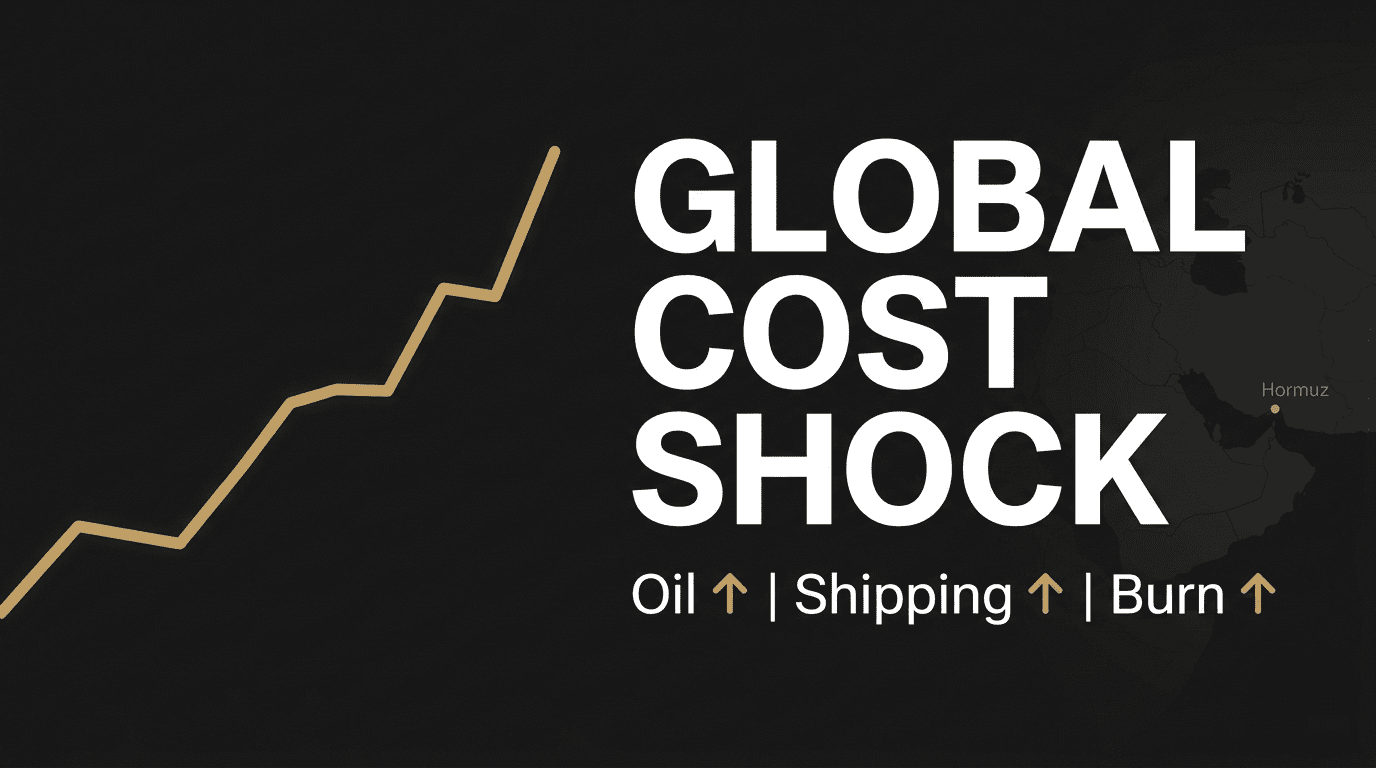

The global economy is already reacting. Most businesses are still underestimating what comes next.
One month into the conflict that began on February 28, the Iran-US war is no longer just a geopolitical headline. It has become a full-scale economic disruption.
The effective shutdown of the Strait of Hormuz, a chokepoint responsible for nearly 20 percent of global oil flows, has triggered a sharp spike in crude prices, pushed jet fuel costs higher, and forced supply chains into expensive reroutes.
Business surveys across the US, Europe, and Japan now show the fastest energy-driven cost increases since 2022. At the same time, growth is slowing while inflation expectations are rising again.
This is the worst combination for any economy. Costs go up. Demand goes down.
That is where real damage begins.
Airlines Are Getting Hit First and Fastest
Airlines operate on thin margins even in stable conditions. Fuel already accounts for up to 40 percent of operating costs.
Now that pressure has intensified.
Jet fuel prices have surged since late February, forcing airlines to rethink pricing and routes almost overnight.
United Airlines has warned that sustained high fuel costs could add billions to annual expenses. The response has been immediate. Route cuts on low-margin sectors and fare increases of up to 20 percent on new bookings.
Delta Air Lines and American Airlines have both indicated hundreds of millions in additional quarterly fuel costs. At the same time, early signs of demand slowdown are emerging, particularly in international travel.
Low-cost carriers like easyJet are also preparing for price hikes, which could impact travel demand further.
Cruise operators face even greater risk. Companies like Carnival, with limited fuel hedging, are directly exposed to rising bunker fuel costs.
Insight: Airlines do not collapse because of demand shocks alone. They collapse when cost spikes hit faster than pricing power can respond.
Global Shipping Is Slowing Down and Getting Expensive
Shipping companies have already started rerouting vessels away from the Gulf.
The alternative route around the Cape of Good Hope adds up to two weeks per journey. That means higher fuel consumption, increased operational costs, and delayed deliveries.
Major players including Maersk, CMA CGM, Hapag-Lloyd, and MSC have restricted or paused bookings to key ports in the region.
Insurance is becoming another bottleneck. War-risk premiums have surged, and some insurers have withdrawn coverage entirely.
The result is a classic supply chain squeeze.
- Lower shipping capacity
- Longer delivery timelines
- Rising freight costs
Industries from electronics to pharmaceuticals are already feeling the impact. Smaller businesses are the most vulnerable because they lack pricing power.
Insight: Supply chain disruption does not hit all players equally. It punishes those with the least control over pricing and logistics.
Cloud Infrastructure Is Now a Real Risk Layer
The impact is no longer limited to physical supply chains.
Digital infrastructure is now exposed.
Recent drone strikes damaged multiple data center facilities in the Gulf region, affecting cloud operations and causing outages across banking systems, logistics platforms, and enterprise software.
Companies relying heavily on centralized cloud regions were forced to shift workloads under pressure.
This is a risk that most businesses have not priced in.
Cloud was assumed to be stable, scalable, and geographically resilient. That assumption is now being tested.
Indian Startups Are Quietly Feeling the Pressure
For Indian founders, the impact is already visible in unit economics.
Rising energy and logistics costs are increasing expenses across:
- Cloud infrastructure
- Delivery operations
- Office and operational overhead
- Raw material sourcing
SaaS companies with exposure to Gulf markets are seeing slower expansion decisions. Deeptech and manufacturing startups are facing renewed input cost volatility.
This is where many startups break, not loudly, but gradually.
When costs rise 20 percent and revenue growth slows, burn rates become unstable.
Runways shrink faster than expected.
Capital efficiency stops being a metric and becomes survival.
The Bigger Risk Most Founders Are Missing
The immediate impact is visible in costs and margins.
The deeper risk is strategic.
Many startups are still operating with assumptions built in stable global conditions. Those assumptions no longer hold.
Supply chains are no longer predictable. Energy prices are no longer stable. Infrastructure is no longer guaranteed.
Businesses that fail in this environment will not fail because of a single mistake. They will fail because their model was not designed for volatility.
Outlook: What Happens Next
The situation remains uncertain.
If the Strait of Hormuz reopens fully, pressure on oil and logistics could ease. But if disruption continues, inflation will stay elevated and global growth will slow further.
Companies that survive this phase will share a few characteristics:
- Strong balance sheets
- Flexible cost structures
- Effective risk management
There will also be opportunity.
Defense technology, renewable energy, and supply chain localization are likely to see increased investment and demand.
The environment is shifting from growth at all costs to resilience under pressure.
The Bottom Line
The Iran-US conflict is not just a geopolitical event. It is a stress test for global business models.
Companies that rely on stable inputs, predictable logistics, and low-cost scaling are now exposed.
The winners will not be the fastest-growing companies.
They will be the ones built to absorb shocks.
VentureBrief Insight
Global conflicts no longer stay isolated. They move quickly into balance sheets, cost structures, and business strategy. The startups and companies that succeed in this environment will be those that treat volatility as a constant, not an exception. Building for efficiency is no longer enough. Building for resilience is becoming the real competitive advantage.